From mechanical structural components and electrical conductive parts to automotive lightweight assemblies and construction frameworks, aluminum materials occupy an irreplaceable position in modern global manufacturing. Aluminum sheets, tubes, bus bars, solid bars and extruded profiles are widely adopted across machinery, new‑energy power transmission, transportation and building sectors. Many buyers only focus on alloy grades and outer dimensions when placing orders, yet overlook heat treatment, the core procedure that directly decides final mechanical performance. Even with identical chemical composition, aluminum products will deliver completely different strength, hardness, dimensional stability and corrosion resistance if processed with improper thermal cycles. For overseas purchasers, fully grasping how aluminum alloy heat treatment operates helps to avoid quality risks and select suitable material solutions for real‑world projects.
Pure aluminum features outstanding ductility but relatively low strength. Its annealed tensile strength generally stays between 60‑90 MPa, so it cannot bear heavy loads independently. Most widely‑used industrial aluminum products rely on alloying elements plus precise heat treatment to achieve balanced comprehensive performance. Common heat‑treatable grades cover 6061, 6063 from 6xxx series, high‑strength 7075 of 7xxx series and 2024 belonging to 2xxx series. These alloys contain magnesium‑silicon, zinc‑magnesium or copper elements whose solubility in solid aluminum changes drastically under varying temperatures. Heat‑treatment technology makes full use of this metallurgical property: by adjusting temperature and holding time, manufacturers control the precipitation status of second‑phase particles inside metal grains, block dislocation movement and realize significant reinforcement. It should be noted that not all aluminum can be hardened via heat treatment. 1xxx pure aluminum, 3xxx and 5xxx aluminum‑magnesium materials gain strength mainly through cold rolling and stretching, and can only be softened by annealing instead of precipitation hardening.
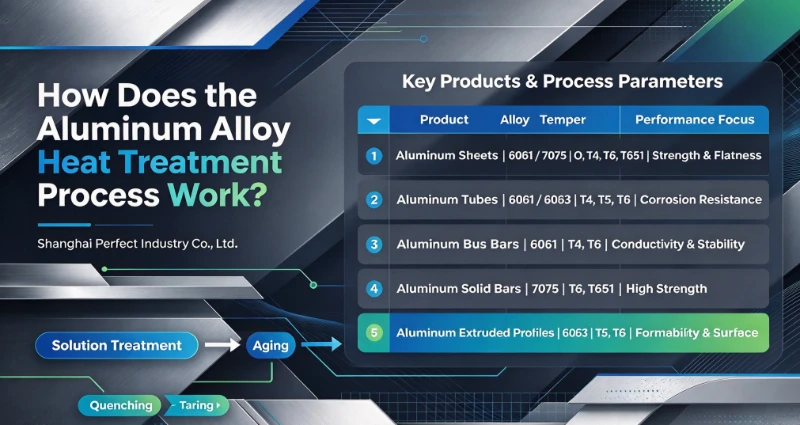
A complete heat‑treatment workflow for heat‑treatable aluminum consists of three key sequential phases: solution heat treatment, quenching and aging. Every phase imposes strict requirements on temperature, holding duration and cooling speed, and tiny parameter deviation will cause batch‑level quality defects for sheets, tubes, bars and profiles.
Solution heat treatment acts as the foundation of whole strengthening procedure. Aluminum workpieces including plates, seamless tubes, aluminum bars and extruded profiles are heated to 480‑580°C according to corresponding alloy specifications. During sufficient heat preservation, coarse alloy‑rich particles dissolve fully into the aluminum matrix and form homogeneous solid solution throughout cross‑sections. Uniform micro‑structure after solution treatment sets preconditions for subsequent aging hardening. Too low heating temperature leads to incomplete dissolution of alloy elements and insufficient final strength. Over‑heating will trigger grain boundary incipient melting, bringing permanent damage that cannot be repaired. Hence production furnaces need tight temperature uniformity control to guarantee consistent heating effect for the whole batch of aluminum semi‑finished goods.
Once solution soaking finishes, quenching must be executed without delay. Products are rapidly transferred into water or polymer quenching medium for fast cooling. The core goal is to lock dissolved alloy atoms within aluminum lattice and maintain supersaturated solid‑solution condition. If cooling proceeds too slowly, solute atoms will separate out prematurely into coarse grains, and material will lose potential for later strength improvement. Quenching inevitably generates residual internal stress. For thick aluminum sheets, large‑diameter solid bars and big‑size extruded profiles, uneven cooling between surface and core easily causes bending or twisting deformation. That explains why many finished products adopt 1.5%‑2.5% stretching operation after quenching for stress relief. Such processing corresponds to widely‑seen T651 and T6511 temper designations on inspection documents, which represent stress‑relieved status after quenching.
Aging is the critical stage where target strength comes into being. Right after quenching, aluminum remains soft and deformable. As time goes by or moderate heat is applied, supersaturated solute atoms precipitate out and form massive ultra‑fine nano‑scale reinforcing particles. Natural aging takes place under room temperature for days or weeks and generates T4 temper with medium strength and good formability. Artificial aging is more popular for mass industrial production: materials are heated to 120‑190°C and kept for scheduled hours to accelerate precipitation reaction and obtain high‑strength T6 temper. Manufacturers must abide by certified aging curves strictly. Insufficient aging cannot unlock full mechanical indicators, while over‑aging will make fine precipitates coarsen and result in strength drop. Aging furnaces normally keep temperature fluctuation within ±5°C to stabilize output quality.
Precipitation hardening serves as the underlying metallurgical principle. During aging, solute atoms first form tiny Guinier‑Preston zones, then evolve into metastable precipitates coherently matched with aluminum crystal lattice. These evenly scattered micro‑particles hinder dislocation movement effectively. When external load is applied, dislocations responsible for plastic deformation cannot easily pass through these barriers, so hardness and tensile strength get greatly enhanced. Different alloy systems produce different precipitated phases: Mg₂Si dominates for 6xxx series sheets, tubes and profiles; MgZn₂ for high‑strength 7075 bars and plates; Al₂Cu compounds for 2xxx aerospace aluminum materials.
Temper codes carry vital processing information for global buyers.
It is noteworthy that aluminum with identical chemical composition will behave totally differently under diverse tempers. International customers are supposed to specify both alloy grade and temper clearly while submitting purchase orders for sheets, tubes, bus bars, bars or profiles.
Multiple control points determine whether heat‑treated aluminum meets procurement requirements. Furnace temperature uniformity ensures stable performance across the full batch. Quench delay, the interval from furnace discharge to immersion in quenching liquid, should be minimized especially for thick‑gauge sheets and large‑size bars. Aging time and temperature must comply with official technical specifications for target alloys. Reliable suppliers carry out hardness and tensile sampling test for every lot and issue mill test certificates with authentic test data for traceability.
Well‑executed heat‑treatment optimizes comprehensive material performance in real‑world applications. Properly treated 7075‑T651 aluminum bar can reach tensile strength over 500 MPa, achieving steel‑comparable strength while retaining low‑density merit. Standard T6‑temper sheets and bars deliver excellent machinability for high‑precision CNC cutting. Reasonable precipitate distribution improves anti‑corrosion performance, making aluminum tubes and profiles competent for humid coastal operating environments. Stress‑relieved tempers greatly lower deformation risks during machining, satisfying strict dimensional tolerance requirements of power‑conductive aluminum bus bars and mechanical structural components.
Global market demand for qualified heat‑treated aluminum keeps expanding continuously. New‑energy power industry purchases large quantities of 6061‑T6 aluminum bus bars for energy storage and power transmission projects. Machinery factories adopt 6061‑T6 sheets, tubes and solid bars for equipment frames and spare‑part manufacturing. Transportation sector selects high‑strength 7075 bars and plates for lightweight structural assemblies. Construction markets consume massive 6063‑T5 / T6 extruded profiles for building curtain walls and support frameworks. In all cross‑border procurement activities, clients are not merely purchasing raw aluminum semi‑products, but consistent thermal processing quality behind each shipment.
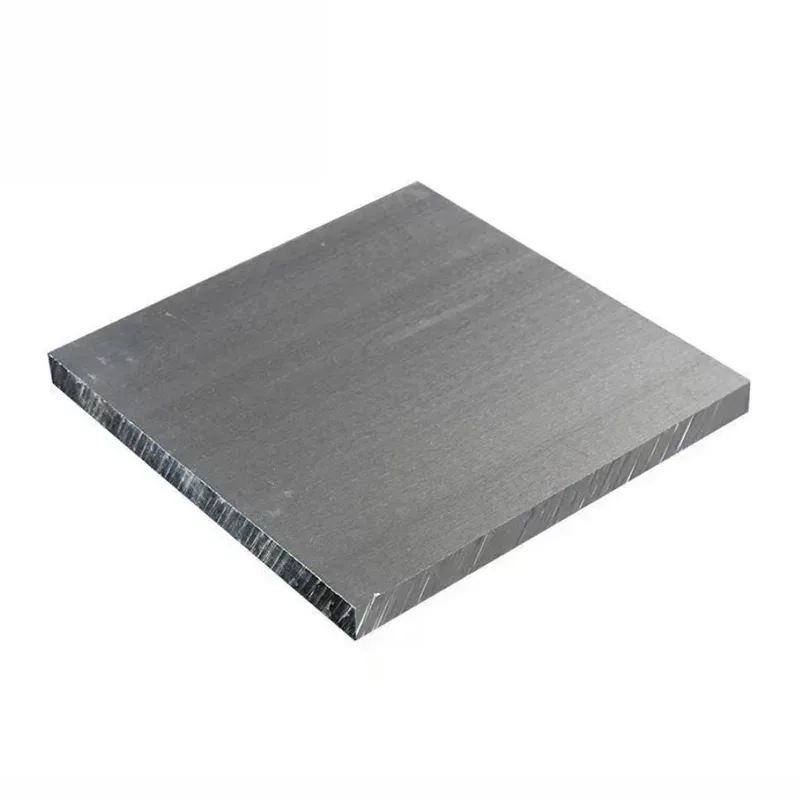
Stable heat‑treatment quality cannot be separated from experienced and responsible material suppliers. Shanghai Perfect Industry Co., Ltd. specializes in supplying a comprehensive portfolio of aluminum products including aluminum sheets, aluminum tubes, aluminum bus bars, aluminum solid bars and aluminum extruded profiles for global customers, covering machinery, new‑energy power, transportation, construction and other industrial fields.
The company provides mainstream heat‑treatable aluminum grades such as 6061, 6063 and 7075, supporting full temper options ranging from O, T4 to T6 and T651 for sheets, tubes, bus bars, bars and profiles. Every order is manufactured, inspected and delivered strictly according to customer‑confirmed alloy, temper, dimension and tolerance requirements, with complete mill test certificates provided for verification. Shanghai Perfect Industry Co., Ltd. cooperates with certified processing partners whose thermal‑treatment facilities receive regular calibration. All solution, quenching and aging parameters are fully documented, so overseas importers receive aluminum goods with verifiable and stable mechanical properties instead of products with unguaranteed performance.
Beyond product quality management, Shanghai Perfect Industry Co., Ltd. positions itself as a reliable long‑term procurement partner for worldwide buyers. Flexible order sizes are available from small trial orders up to full container loads. The team completes standardized export documentation and arranges stable international logistics solutions. Multilingual‑support sales engineers offer timely communication throughout the whole order cycle. Whether clients need 6061‑T651 aluminum sheets for mechanical processing, seamless aluminum tubes for fluid transmission, aluminum bus bars for power projects, solid aluminum bars for CNC machining or customized extruded profiles for construction, technical staff will sort out precise specification requirements in advance, preventing unnecessary losses caused by improper temper or parameter selection.
In summary, aluminum alloy heat treatment belongs to highly‑demanding precision metallurgical technology. Manufacturers dissolve alloying elements under high‑temperature solution treatment, lock micro‑structure status through rapid quenching, and generate reinforcing precipitates by controlled aging cycles. This set of thermal processes converts ordinary aluminum into lightweight, high‑performance industrial materials widely adopted across multiple industries. For international purchasers and technical engineers, it is critical to define both alloy grade and temper in purchasing documents, and prioritize suppliers capable of offering traceable heat‑treatment records. Working with professional suppliers like Shanghai Perfect Industry Co., Ltd., global importers can source consistent‑quality aluminum sheets, tubes, bus bars, bars and profiles to guarantee smooth progress of overseas projects.