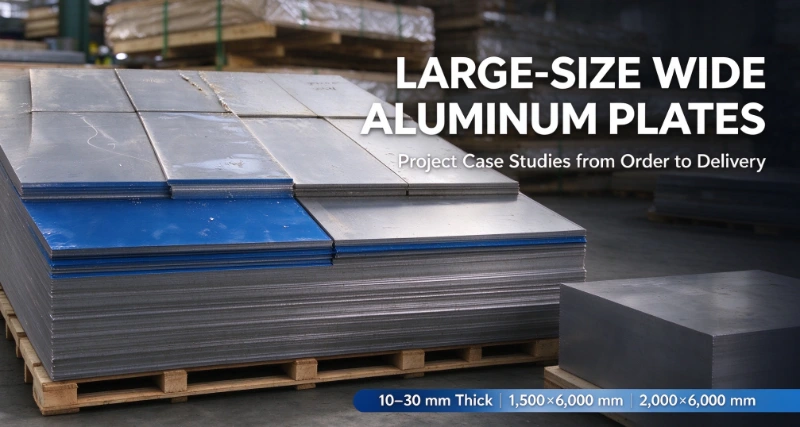
In shipbuilding, offshore engineering, pressure vessel manufacturing and heavy transport, one material decision often determines both the performance and the total cost of an entire project: the aluminum plate. Among the many specifications available on the market today, large-size wide aluminum plates — typically 1,500 × 6,000 mm and 2,000 × 6,000 mm in dimension, with thicknesses from 10 mm to 30 mm — have become the preferred choice for engineering teams that value fewer welds, shorter fabrication cycles and more stable joint quality. This article shares several real project cases of large-size wide aluminum plates, and explains how the right material partner turns a demanding specification into a smooth, on-time delivery.
Why do engineers keep asking for wider and longer plates? The answer lies in fabrication efficiency and structural integrity. When a ship hull panel or a storage tank shell is built from narrow plates, it requires more longitudinal and transverse weld seams. Every weld is a potential weak point, a source of distortion, and a cost item — in labor, in consumables and in inspection.
A wide plate of 2,000 mm dramatically reduces the number of weld seams. Fewer seams mean stronger and more uniform structures, shorter welding time, lower risk of welding defects, and less material waste from cutting and fitting. For applications that operate under harsh conditions — seawater corrosion, high pressure, heavy dynamic loads — the benefit is even more obvious: a structure with fewer joints is simply more reliable over its service life.
Large plates also speed up CNC cutting and forming processes. More finished parts can be nested on a single sheet, which improves material utilization and reduces unit cost. This is why wide aluminum plates have become standard in marine engineering, storage tank fabrication, truck body manufacturing and large architectural projects.
Case Study 1: Large-Size Wide Aluminum Plates for Marine and Offshore Engineering
One of the most representative applications of large-size wide aluminum plates is marine and offshore engineering. In a recent shipbuilding project, our team matched the customer’s working environment and load requirements and supplied customized wide aluminum plates with suitable alloy grades and tempers, in thicknesses of 10, 12, 15, 20, 25 and 30 mm, in both 1,500 × 6,000 mm and 2,000 × 6,000 mm formats, for the construction of hull structures and superstructure components.
Marine-grade aluminum alloys are favored for their excellent corrosion resistance in seawater environments and outstanding weldability. Properly selected tempers deliver an ideal balance of strength and corrosion resistance, and have become a benchmark for boat and ship construction worldwide.
For the shipyard, the decision to use 2,000 mm wide plates was a game changer. The wider panels allowed the fabrication team to reduce the number of butt welds along the hull shell by roughly one third compared with conventional 1,250 mm plates. Welding distortion was noticeably reduced, which made the subsequent fairing and painting processes faster and more accurate. The project was completed ahead of the planned schedule, and all plates passed the required dimensional and mechanical verification without rework.
The lesson from this case is simple: when a shipyard chooses the right alloy, the right temper and the right plate width at the design stage, the benefit is reflected not only in material cost but in the entire fabrication workflow.
Case Study 2: Wide Aluminum Plates for Pressure Vessels and Storage Tanks
Large-size aluminum plates also play a critical role in the production of pressure vessels and atmospheric storage tanks. For large-diameter tank shells, plate width directly determines how many longitudinal welds are needed. A 2,000 mm wide plate can reduce the number of shell courses and longitudinal seams significantly, which improves both welding efficiency and the roundness consistency of the finished tank.
In one tank fabrication project for an industrial client, we selected suitable aluminum alloys and delivered 2,000 × 6,000 mm wide plates that shortened the shell welding cycle by roughly 20% and simplified the fit-up process. Because the plates were supplied with tight thickness tolerance and controlled flatness, the fabricators saved considerable time on gap adjustment and distortion correction — often the most unpredictable part of tank production.
For pressure vessel manufacturers, dimensional consistency is not a luxury but a requirement. Plates that vary in thickness or flatness force welders to compensate manually, which slows production and risks quality issues. Supplying plates that are already flat, dimensionally accurate and uniform in mechanical properties allows fabricators to focus on welding and assembly rather than on correcting material problems.
Case Study 3: Large-Size Aluminum Plates for Truck and Trailer Manufacturing
In the transport industry, weight is money. Every kilogram saved on the vehicle structure becomes additional payload capacity, lower fuel consumption and reduced emissions. Wide aluminum plates have become a standard solution for truck and trailer floor systems, where heat-treatable aluminum alloys are frequently selected for their combination of strength, formability and corrosion resistance.
A 2,000 mm wide floor plate can cover the full width of a standard trailer without a center seam, eliminating the most vulnerable joint of the floor — the seam through which water, salt and dirt can enter the structure. In a recent fleet upgrade project, the customer replaced steel floor panels with wide aluminum plates, cutting the floor weight by more than half while maintaining the required load-bearing strength. The installation team also reported faster assembly, because the wider panels meant fewer pieces to handle, fewer joints to seal and better overall flatness of the finished floor.
The result was a measurable increase in payload capacity for the fleet operator and a longer service life for the vehicles, thanks to the corrosion resistance of aluminum in road-salt and moisture environments.
Case Study 4: Exporting Wide Aluminum Plates to Kazakhstan and Central Asia
Beyond coastal industries, demand for wide aluminum plates is growing rapidly in landlocked markets. In a recent project for an industrial client in Kazakhstan, our company supplied a complete package of wide aluminum plates for structural applications. We recommended matched alloy solutions according to the local climate and project load conditions.
Most of the plates were 6,000 mm long and were delivered by road freight from our Shanghai warehouse to Almaty — a route our export team handles on a regular basis. For customers in Central Asia and Russia, the biggest concerns are usually delivery time, documentation and packaging. To meet these concerns, we arranged steel-framed wooden crates, protective interleaving paper and edge guards so that the plates arrived free of scratches, moisture damage and deformation. All shipping documents, including mill certificates, packing lists and certificates of origin, were prepared in advance, which allowed smooth customs clearance at the border and on-time arrival at the project site.
This case shows that for wide aluminum plates, the supplier's logistics capability is as important as the material quality itself. A 6,000 mm plate that is perfect in the warehouse but damaged or delayed in transit is of little value to a project waiting on a critical schedule.
Quality Control and Standards for Large-Size Wide Aluminum Plates
Behind every successful wide-plate project are strict quality requirements: chemical composition per the alloy standard, mechanical properties, thickness tolerance per EN 485 or ASTM B209, flatness control and surface quality. For marine applications, standards such as ASTM B928 additionally require specific corrosion performance verification.
Every plate should be traceable to its production lot, supported by a full mill test certificate. Many international customers also request third-party inspection — for example by SGS, BV or TÜV — before shipment, and a reliable supplier should be able to arrange this without delaying the schedule.
In addition to standard sizes, professional suppliers offer value-added processing: cutting to size, edge milling, drilling and surface protective film, so that plates arrive ready for production. This reduces handling time at the customer's workshop and protects the surface from scratches during storage and installation.
Packaging and Logistics for Wide Aluminum Plates
Six-meter plates demand professional handling. Standard export packaging for wide aluminum plates includes steel-reinforced wooden crates, anti-moisture paper and plastic film, edge protectors and clearly marked lifting points. Proper packaging prevents the two most common problems in wide-plate transport: surface scratching and permanent deformation.
From a logistics point of view, 2,000 × 6,000 mm plates fit standard 40-ft containers efficiently, while larger consignments can be shipped on flat racks or by bulk vessel. For landlocked destinations in Central Asia and Russia, experienced suppliers offer road freight with full-door delivery, and flexible trade terms such as FOB, CIF and DDP. A supplier that can quote the whole route — from mill to project site — saves the customer significant coordination effort.
Why Choose Shanghai Perfect Industry Co., Ltd. for Aluminum Plates?
Shanghai Perfect Industry Co., Ltd. is a professional supplier of aluminum plates, sheets and profiles, serving customers in more than 20 countries across Asia, Europe, the Middle East and Latin America. We specialize in 1xxx-7xxx series alloys — including 1050, 3003, 5754, 6061, 6063, 6082 and 7075 — in a wide range of tempers such as H14, H16, H321, T3, T6 and T651.
Our stock program and close cooperation with mills allow us to supply large-size wide aluminum plates from 10 mm to 30 mm thickness, with flexible cutting services and competitive lead times. Every order is backed by complete documentation: mill certificates, inspection reports, certificates of origin and, upon request, third-party inspection.
Our international sales team communicates in English and Russian, and has solid experience in export logistics to Russia, Central Asia, Southeast Asia, the Middle East and Latin America — including regular road freight to Kazakhstan and sea freight to major ports worldwide. We treat every specification as a commitment: the alloy must match the application, the tolerance must match the drawing, and the delivery must match the schedule.
Conclusion
Large-size wide aluminum plates are not just a product category; they are a solution to real engineering problems — fewer welds, stronger structures, lower fabrication costs and faster project completion. From ship hulls at sea to storage tanks on land and truck floors on the highway, the right plate, in the right size and alloy, makes a measurable difference.
If your next project calls for wide aluminum plates, choosing an experienced partner who understands both material science and international logistics is half the battle won. The other half is a specification sheet that is clear — and a supplier that takes it seriously.
We use cookies to offer you a better browsing experience, analyze site traffic and personalize content. By using this site, you agree to our use of cookies. Privacy Policy